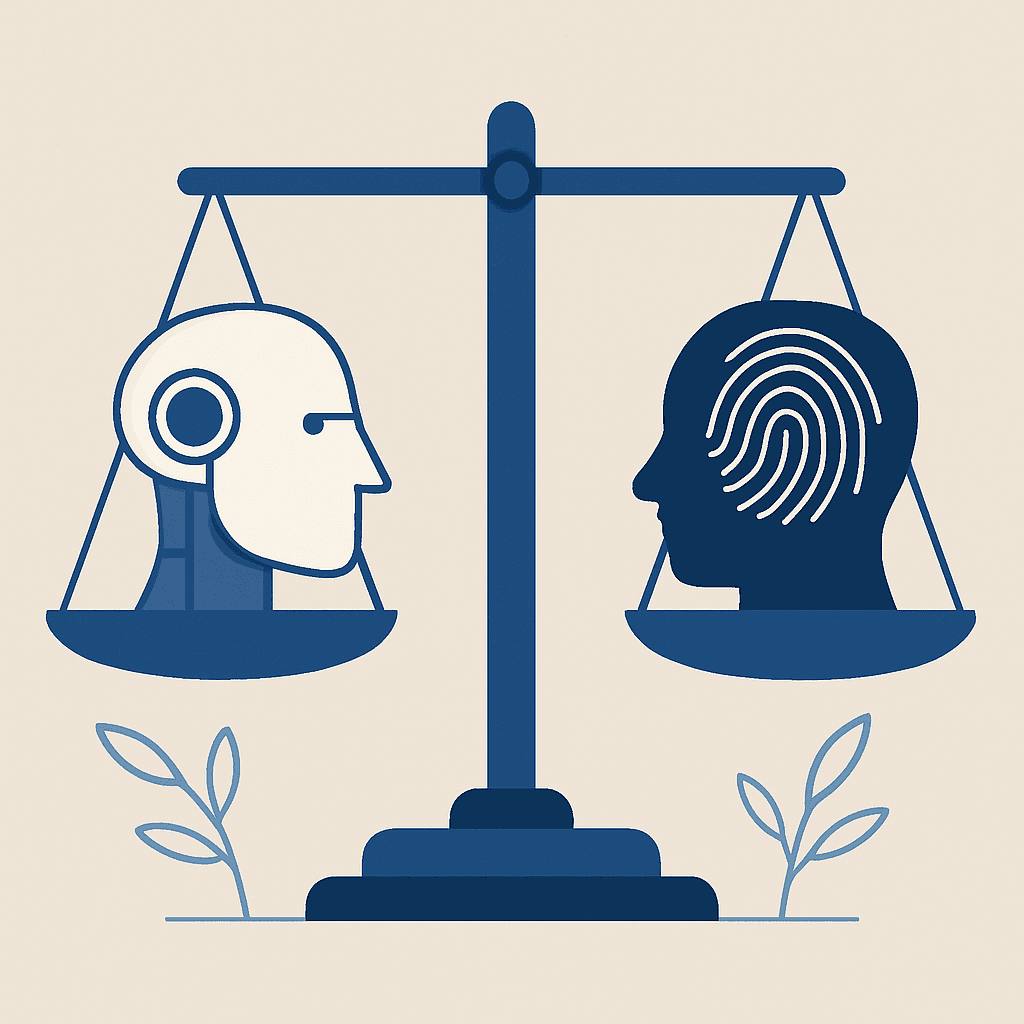
From smart assistants to autonomous vehicles, artificial intelligence (AI) is no longer a futuristic concept — it’s embedded in our daily lives. While this technological leap has the potential to reshape industries, improve healthcare, and streamline decision-making, it also raises profound ethical questions.
As AI continues to evolve rapidly, we must ask: Are we building a fair, transparent, and safe future for everyone? This blog explores AI’s key ethical considerations, including bias, privacy, and decision-making, and why responsible development is more crucial than ever.
The Problem of Bias in AI
AI systems learn from data. But if that data reflects human prejudices or historical inequalities, the AI can inherit — or even amplify — those biases.
A notable example is facial recognition technology, which has shown significantly higher error rates for people with darker skin tones due to non-diverse training datasets. Similarly, automated hiring tools have been found to prefer certain demographics based on skewed historical hiring data.
How do we address bias in AI?
-
Inclusive datasets: Diverse and representative data reduce skewed outcomes.
-
Explainable AI: Transparent algorithms help users understand how decisions are made.
-
Human-in-the-loop systems: Combining human judgment with machine efficiency can help mitigate bias in high-stakes areas like criminal justice or medical diagnoses.
Privacy in the Age of Data-Driven AI
AI-powered platforms rely heavily on data, sometimes at the expense of individual privacy. Virtual assistants, predictive analytics, and recommendation engines all collect personal data to function efficiently. However, this constant data harvesting raises concerns about surveillance and consent.
Take, for example, social media platforms using AI to analyze user behavior for targeted advertising. While this improves user experience and revenue, it often happens without explicit consent or awareness.
Steps toward ethical AI privacy practices:
-
Transparency: Users should know what data is collected and how it’s used.
-
Consent-based models: Data sharing should be opt-in, not default.
-
Compliance with regulations: Frameworks like Europe’s GDPR or India’s Digital Personal Data Protection (DPDP) Act are critical for enforcing responsible data use.
Who Decides? AI and Autonomous Decision-Making
One of the most controversial ethical issues in AI is its growing role in decision-making, especially in areas where human judgment is vital.
From predicting recidivism in legal systems to diagnosing patients or approving loans, AI is being entrusted with choices that can profoundly affect lives. But what happens when these systems make mistakes? Who is held accountable — the programmer, the user, or the machine?
Why decision-making by AI needs scrutiny:
-
Lack of empathy: Machines lack the human touch, often vital in fields like healthcare.
-
Opaque logic: Many deep learning models work as black boxes, offering no insight into how they concluded.
-
Need for accountability: Human oversight must remain central to any system that influences lives or liberties.
Social and Economic Inequality
AI is often heralded as an equalizer, but it can also deepen divides if not implemented ethically. In developing countries, AI could unlock new opportunities in agriculture, education, and healthcare. Yet, without equitable access to AI tools and digital literacy, the benefits may remain concentrated in the hands of a few.
Moreover, automation threatens job displacement in sectors like manufacturing and customer service, especially for low-income and low-skill workers.
A responsible path forward:
-
Inclusive innovation: Ensure marginalized communities are part of the AI conversation.
-
Education and reskilling: Equip the workforce with skills to thrive in an AI-driven economy.
-
Public-private collaboration: Governments, businesses, and civil society must work together to ensure AI serves the many, not the few.
The Way Ahead: Innovation with Integrity
Ethical AI is not a luxury — it’s a necessity. The choices we make today will shape the technological, social, and moral landscape of tomorrow.
To balance innovation with responsibility:
-
Build ethics into the design process from day one.
-
Foster interdisciplinary collaboration between technologists, ethicists, sociologists, and policymakers.
-
Promote global standards and regulations that safeguard public interest.
AI can uplift humanity — but only if guided by fairness, transparency, and accountability. The future of AI is not just about what it can do, but what it should do